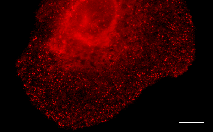
HeLa cell expressing fusion of canine Rab5a with FusionRed.
The fusion protein is localized in the endosomes.
Scale bar represents 10 μm. Data from Shemiakina et al., 2012
pFusionRed-Rab5a is a mammalian expression vector encoding FusionRed-Rab5a fusion protein (see reporter description). The vector can be used for fluorescent labeling of Rab-5A protein in living cells.
| HeLa cell expressing fusion of canine Rab5a with FusionRed.The fusion protein is localized in the endosomes. |
FusionRed codon usage is optimized for high expression in mammalian cells (humanized) [Haas et al., 1996]. Human Ras-related protein Rab-5A is fused to the FusionRed C-terminus. To increase mRNA translation efficiency, Kozak consensus translation initiation site is generated upstream of the FusionRed-Rab5a coding sequence [Kozak, 1987].
pFusionRed-Rab5a vector can be used as a source of FusionRed-Rab5a hybrid sequence. The vector backbone contains unique restriction sites that permit its excision and further insertion into expression vector of choice.
Note: The plasmid DNA was isolated from dam+-methylated
The vector backbone contains immediate early promoter of cytomegalovirus (PCMV IE) for protein expression, SV40 origin for replication in mammalian cells expressing SV40 T-antigen, pUC origin of replication for propagation in
SV40 early promoter (PSV40) provides neomycin resistance gene (Neor) expression to select stably transfected eukaryotic cells using G418. Bacterial promoter (P) provides kanamycin resistance gene expression (Kanr) in
Expression in mammalian cells
pFusionRed-Rab5a vector can be transfected into mammalian cells by any known transfection method. CMV promoter provides strong, constitutive expression of the FusionRed-Rab5a fusion in eukaryotic cells. If required, stable transformants can be selected using G418 [Gorman, 1985].
Propagation in
Suitable host strains for propagation in