
| Variant | Description | Related vector | Cat.# | Click for image |
|---|---|---|---|---|
| ||||
| Humanized TurboGFP | TurboGFP codon usage is optimized for high expression in mammalian cells [Haas et al., 1996], but it can be successfully expressed in many other heterological systems. |
|
FP511 | |
|
|
FP512 | |||
|
|
FP513 | |||
|
|
FP515 | |||
|
|
FP521 | |||
|
|
FP522 | |||
| Destabilized TurboGFP variant (TurboGFP-dest1) | TurboGFP-dest1 is produced by fusing the initial protein with PEST amino acid sequence encoded by region 422-461 of mouse ornithine decarboxylase gene [Li et al., 1998]. This sequence targets the protein to degradation and enables a rapid protein turnover. TurboGFP-dest1 retains spectral properties of the initial protein, but has shorter half-life (approximately 2 hrs) as measured by the analysis of fluorescence intensity of cells treated with a protein synthesis inhibitor, cycloheximide. Because of rapid turnover, TurboGFP-dest1 can be used to measure changes in gene expression. |
|
FP523 | |
|
|
FP524 | |||
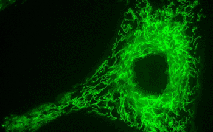
| TurboGFP-mito fusion | A mitochondrial targeting sequence (MTS) is fused to the TurboGFP N-terminus. MTS was derived from the subunit VIII of human cytochrome C oxidase [Rizzuto et al., 1989; Rizzuto et al., 1995]. When expressed in mammalian cells, this variant provides green fluorescent labeling of mitochondria. |
|
FP517 |
|